
Using Resistance to Create
Lisa Richardson’s take on the current times.

We’re living in the Great Turning, the Great Simplification.
The Pirates are in charge, running the ship onto jagged rocks, while we fold laundry, plant carrots, work, and pay the gas bill. Two separate realities, yet we can feel in our bones that things are breaking down rapidly. What to do?
Some are staying angry, protesting, calling, boycotting the overlords. Glued to the news. Some are oblivious or too busy with surviving, or exhausted, numbing out. Some creatives are joyfully making art, building community and resilience, and stories of a better future. Some of us do all three, or try to.
The Thrutopia Project is here to engage our imaginations, telling stories of a better future that we would be proud to leave behind to our Seventh Generations. Engaging imagination and play is the remedy for despair and burn out, as Lisa Richardson so beautifully writes. How to do it? Ray Bradbury has some advice.

Seeking outlets for love and rage
I interviewed mountain biker Casey Brown fourteen years ago, and have never forgotten the thing she shared, that her dad taught her, that powered her racing. When you ride, he advised, “Put all your love and hate into it.”
The thing that struck me in this Wise-Dad-Counsel was the baseline acknowledgement to his daughter, that: of course you have hate or rage. Don’t bury it. Don’t deny it. Don’t try and make it go away. Channel that, alongside your love. Don’t wait until it wears off before you do your thing. It can all be your fuel.
We are living in rage-making times. Bewildering, heart-breaking, worrying. I won’t give you the litany of proof points - before I get to the end of the list, we’ll all have to crawl back into bed, pull the covers up over our heads, and revert to doing whatever it is we do to numb out and stop feeling at all. But what if we stay with the feelings… not let any particular one get stuck, but allow them, even greet them, with varying degrees of warmth or cool courtesy, as you do when you’re moving through the world encountering humans you variously love and loathe.
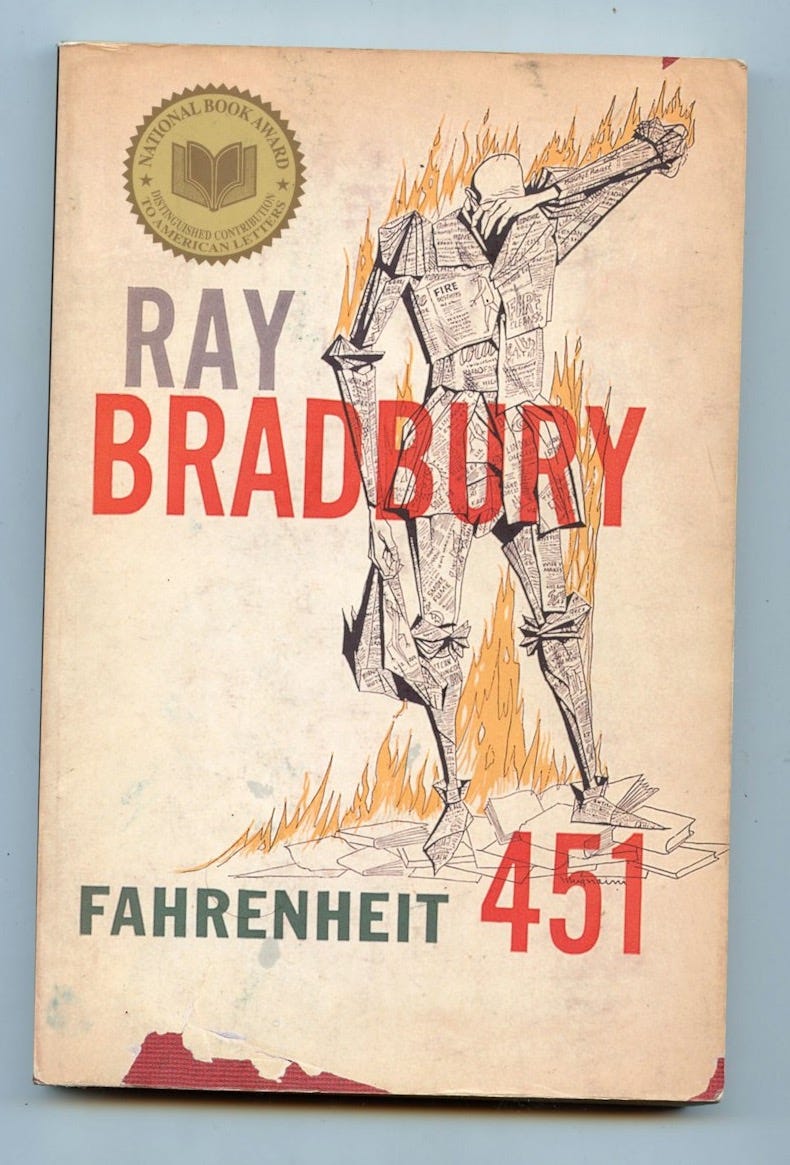
Ray Bradbury wrote Fahrenheit 451 in 1953 while living through the McCarthy-era “Red Scare” during which a small venal man witch-hunted artists, intellectuals and thinkers who didn’t toe the party line. Bradbury wrote on a typewriter you could rent by the hour in a local library. The novel is set in a dystopic near future where books are burned to maintain the “intellectual peace” that comes when no-one thinks anything other than what the government wants them to think, what’s being broadcast to them through their screens.
Bradbury later said: “I tell people, Make a list of ten things you hate and tear them down in a short story or poem. Make a list of ten things you love and celebrate them. When I wrote Fahrenheit 451 I hated book burners and I loved libraries. So there you are.” And here we are: the creative work cracked open revealing the white and the yolk that are his love and his rage.
I’ve been thinking a lot about creative work and resistance, lately. Resistance, in the way Steven Pressfield talks of it, is like magnetic repulsion, a kind of creative block, that stumps and silences you, and keeps you from sitting down to the blank page/canvas/starting block. If you don’t turn to consider it, (“hello Newman”), it can shut you down. But if you track it, notice it, identify it, it becomes data, a kind of signpost, that alerts you to the fact that something important is happening, that something matters to you. That a force field is at work. And you somehow need to flip the magnets so you can get closer to this thing that is exerting such a charge on you.
Resistance, too, means defying an oppressive, powerful and unjust regime, even when the balance of might is against you. Creative work matters here too. Resistance, in the way Rebecca Solnit speaks of it, is about coming together, refusing to be divided, conquered, overwhelmed, or beaten before you get out the gate. She told the New York Times recently, “I think the counter to Trump always has been and always will be civil society. Maybe changing the world is more like caregiving than it is like war. Too many people still expect it to look like war.”
War, or resistance that actively and forcefully pushes back, in any contest of domination, adds power to the strong man, it gives the bully permission to double down, roll out tanks, level up the violence that somehow fuels him even more. The best and most inspiring responses to the crazy things happening in the world right now, for those of us who don’t have economies or armies at our command, have been the creative and care-rich ones… the deep winter street corner singing circles, light shows projected on walls. The poetry folded into Ukrainian first aid kits. Packed out poetry readings in bomb shelters. The humanity. The dignity. The care. The gestures of people resisting the urge to get under the covers and not come back out.
One of the best things my dire social media feed served up in the last month was a story of women who were out on the streets during anti ICE neighbourhood protests in Minnesota, offering people cups of tea. “You look cold, have a cup of tea.” They even offered tea to agents in uniform, successfully de-escalating moments that could have gone sideways fast. At least, that’s what it has become in my mind… a scene in which a teapot becomes the vessel for transmuting all our love and rage into something more civil, something we can actually recover from.
When I asked ChatGPT to serve as my counsellor, and analyse Carney’s and Trump’s World Economic Forum speeches, it offered to also write me a personal 10 point plan on how to live the “middle powers” way, as an ordinary citizen. “Don’t overlook the power of the boring things,” it advised. “It is not your job to outsmart geopolitics. But you are positioned to stabilise your local system. Support boring organizations like local libraries, schools, art institutions and credible journalism. These are legitimacy factories. They’re what foreign manipulation tries to erode first.”
In other words, our community culture is our resilience. The ways we channel and express our love and rage, in and among each other, matters. So, make your art a vessel like a small rubber raft for the sorrows you amass. Make your art your medicine, your herbal apothecary, your physic garden. Make your art through thick or thin. Make your art no matter what, no matter what size it is, no matter how insignificant it feels. Put all your love and hate into it. Let it have it all.
This article was original published in Pique Magazine in March, 2026.
Lisa Richardson is an alumni of the original Thrutopian Writing Masterclass program, and a freelance writer raised in Australia and now based on Canada’s west coast, near Pemberton, on the traditional territories of the Lil’wat Nation. A newspaper columnist and founder of a Secret Poetry Appreciation Society in her community, her writing, speaking and creative workshops are propelled by the idea that attention, imagination and community are where resilience and future flourishing is at. She is currently taking an invented degree in creative play at the Midlife School of Magic, a made-up institution offering life craft pathways for people interested in emergent possibilities. https://lisarichardsonbylines.com/
Thank you for having me here... I find I need constant reminders that my imagination matters, that being creative and playful matters, and is okay, and that feeling equally powered by love and rage/hate is actually okay and one doesn't necessarily cancel the other one out. It's helpful to articulate it, and it's weirdly helpful to have someone say, oh this resonates, let me share it, and to be able to revisit it and think, oh gosh, I do want to believe this. I think I can bet my chips on this.