
The Practopia Project
Searching for hope after America


As the old system crumbles what might rise organically through the cracks? If we escape authoritarian control and slide into the driving seat ourselves, what transitional structures might we build using human initiative, resilience, creativity and cooperation?
Joe Tankersley’s Practopia Project views this emergence through the lens of jaded ex Hollywood screenwriter Johnny Darlin. Johnny has bagged a gig as a roaming reporter, his brief: to share stories of practical utopias where people and planet can thrive, inspiring hope for better futures.
This is a taster episode. The complete series can be found here and you are invited to add to it. Consider your community’s own local traditions, topography, skillsets, strengths, character and resources. What might your experimental community look like or do you already live in one?
Episode 6.2 Farmsteaders of Franklin
Previously, Johnny arrives in Franklin, Tennessee, where he meets farmsteader, Katie, who offers him a room in exchange for labour and invites him to a hoedown.
The hoedown goes into the late hours of the evening. Fortunately, Katie, my host for the night, calls it an evening before the fatigue of days on the road catches up with me. After an extended round of good nights to her friends, we finally find our way back to our bikes.
I pedal behind Katie as she weaves through a maze of suburban streets. Bright moon lights our way. Pull into the driveway of a McMansion from the turn of the century. Mysterious plants stand proud in planter boxes covering the former front lawn.
She parks her bike and trailer in the open garage, slides in between empty crates, bottles, and juice presses. A mini-factory inside a mini-farm in a converted McMansion. Some serious social recycling going on here.
The house’s identity crisis continues inside. Seed catalogs, books, and papers cover a massive rosewood buffet. The dining room table, big enough for a dozen guests, plays host to a disassembled engine of some sort.
The bedrooms are minimally furnished. The one she leads me to has a mattress on the stone floor, crate for a nightstand, single light, dim bulb.
Quick shower gives me the chance to work out the kinks in sore muscles and the conflicts in the local scene. The lukewarm water offers some relief for the first, little insight for the latter.
I find Katie sitting out back, a couple of worn-out loungers on a deck surrounding a pool. Lilly pads float on pitch-black water. She tosses a handful of bread into the pool. Water comes alive.
[WILD SPLASHING OF FISHIN POOL]
JOHNNY: Geez, what kind of monsters you got in your pool?
KATIE: Catfish. Super easy to raise, good source of protein.
JOHNNY: So, uh, not sure I totally get this community. I mean singing farmers, hoedowns, this place. It’s all kinda…
KATIE: like a bad country song? (Laughs)
JOHNNY: No, I didn’t mean. Just not obvious how all the pieces fit.
KATIE: This was a musician’s town. Mainly back-up singers, songwriters, studio musicians. Gigs were regular, Money silly good. Enough to afford a little mansion in the burbs. Told ourselves we had made it, you know. Pretty snobby place back then.
JOHNNY: And you?
KATIE: Guilty as charged. Until…
JOHNNY: The entertainment industry imploded along with the rest of the economy.
KATIE: Before that. The local culture wars got too much to handle. In a state where the politics ran deep red, most of the folks in the industry were forced to be quiet co-conspirators. Afraid to piss off the old white guys in charge. Until…being quiet just wasn’t an option anymore. The choice was clear. Sell our souls or our Luccheses.
JOHNNY: Luccheses?
KATIE: Brand of boot, used to go for a grand a pair. Vintage ones even more. Probably had two dozen pairs at one time.
JOHNNY: So, you got out of the business?
KATIE: I hung on longer than some. Told myself it was about the music. Truth is I liked, hell loved, the attention. Audiences, fans, it’s addicting.
JOHNNY: Hear that.
KATIE: Fortunately for me, I got out while I still had a tiny sliver of my soul left. And this place. Hunkered down to wait it out. When it became obvious things weren’t gonna bounce back looked for other ways to survive.
JOHNNY: And that’s how you became a farmer?
KATIE: Farmsteader. Too damn small an operation to call this a farm. Three-quarters of an acre in vegetables, part ownership of a peach and pecan grove. Fourteen chickens, eight ducks, one goat and a pool full of catfish. Oh, and two guava trees smuggled outta Florida. Enough to get by.
JOHNNY: Gave up a lot.
KATIE: Still get to sing. Now, it’s for people I love, friends, family. Don’t care about how I dress or what awards I might have won. Means way more.
JOHNNY: A community of singing farmers. Gotta be one of a kind.
KATIE: We’re a close-knit community. Funny, when a bunch of super-competitive types realize survival means working together, they can be some fierce collaborators.
JOHNNY: Is it sustainable?
KATIE: One bad drought and things get gnarly fast. Growing seasons are constantly shifting with the rising temperatures. One season too much rain, the next not enough. Who knows how long it’ll last. Til then feels like good work. Healing some of the damage caused by the overbuilding that went on. Gotta be better for the planet than a suburb of autotrons driving gas guzzlers to some expensive grocery store to buy food with names they can’t pronounce. Just because it was the instachic thing to do.
JOHNNY: Don’t you miss the variety that came with that life?
KATIE: We’ve got a pretty diverse population. Lots of transplants from all over. They bring some cool spins to the local crops. Fried catfish curry, refried black-eyed peas, sweet Bok choy slaw. Mother Nature can be generous if you treat her right.
JOHNNY: And what does that take in terms of time and effort?
KATIE: Guess you’ll find out in the morning, eh? I’m gonna crash. Do you need anything
JOHNNY: No, I’m good…thanks. This is a nice break.
KATIE: Sleep well. That old rooster crows damn early.
JOHNNY: Uh, can’t wait.
DAYS ON THE FARMSTEAD START EARLY
(ROOSTER CROWS)
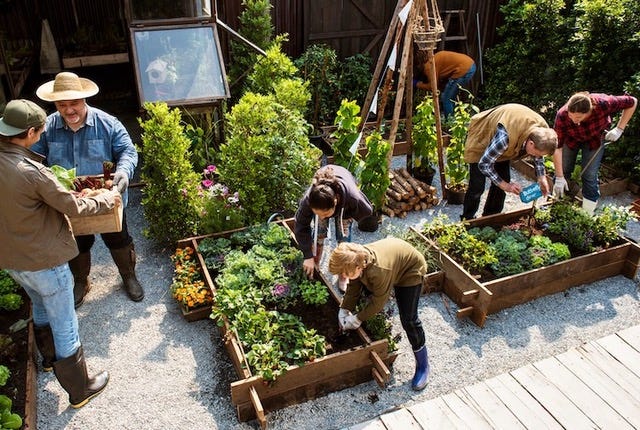
The sun has barely had time to rise when the day begins for the Farmsteaders of Franklin. A cup of strong hot tea, slice of bread slathered in strawberry jam and it’s out to the fields. Well, the front yards at least. An entire neighborhood of former front lawns transformed into intensive garden patches. Planters built from salvaged wood, scrap metal, even repurposed appliances, are bursting with tomatoes, potatoes, watermelons, squashes of every kind.
This is peak growing season. Summer harvest just a few weeks away. Main job is pest control. By literally picking bad bugs off the plants.
Doesn’t take long for my host to recognize my total ineptitude at these jobs. How the hell am I supposed to know the difference between a lacewing and a whitefly? Don’t even get me started on trying to identify good wasps from bad. Anything with a stinger is the enemy, as far as I’m concerned.
Pretty sure it’s an act of self- defense when Katie releases me from my servitude, but I gladly accept. Wander up and down the street. Farmsteaders of all ages tend their patches. This is serious work, even the kids pitch in. By afternoon, the temp and the humidity will be too brutal to work outside. Much to get done in the early hours of the day.
These are def not your grandmother’s tomato gardens. Plenty of innovative techniques designed to maximize output. Sensors in every planter collect surprising amounts of data-soil profiles, moisture levels, probably even bug identifiers. Complex irrigation systems deliver precise amounts of water and nutrients to each plant. All this monitored using vintage cell phones rescued from some e-dump.
[OLD STYLE FARM BELL CLANGS]
Lunch is announced by the peal of a farm bell. Real one, not some lame digital recording. People finish the task at hand, wash up and ramble toward the end of the street where two long wooden tables wait. More people emerge from every house on the block carrying bowls of steaming vegetables, platters of bread, salads, pitchers of tea, juice, and water. A scene out of some rural domestic rom-com. One big difference—jobs are not divided by gender or age here. As many women work in the gardens as men come from the kitchens.
[SOUNDS OF CONVERSATION. DISHES CLANGING. LAUGHTER]
KATIE: So, enjoying lunch?
JOHNNY: Delis, not sure I earned it. Afraid I’m not farmer material.
KATIE: No worries. Takes a while to get the hang. I was a complete klutz when I started, too.
JOHNNY: Can’t imagine that’s true.
KATIE: You’re welcome to stick around. Plenty of other jobs you can try–canning, cooking. Happy to teach you.
JOHNNY: Sounds like just what I need.
REFLECTIONS
As much as I wanted to stay and get to know more about this community and, tbh, one of its members in particular, the Practopia Project had other ideas. By late afternoon, I got the message that it was time to be moving on. Seems there was some sort of time-sensitive assignment they needed me for.
The idea of having to leave was depressing enough. Worse when I found out where they wanted me next. Pretty sure the Free State of Florida is off limits for a project like this.
My Practopia handler assured me that there was an exception, a community doing cutting-edge resiliency work in the home of climate denial. Could be a gamechanger for places getting slammed hardest by mega storms.
Still couldn’t see what the rush was and said so. That’s when they dropped the bomb. This experiment in resiliency was going to get hit by a hurricane, a big one, in the next forty-eight hours.They want me there to ride it out. To document its success. Assuming it works. Great.
So here I am, waiting for an airship that’s going to take me to Florida to ride out a killer hurricane.
Told Katie the news and promised I’d come back, give her that chance to teach me about life as a farmer. She said she hoped I would. Said it like she meant it. So, there’s that.
Not sure I’m really cut out for the life. One morning was enough to convince me how hard the work is. But this community’s def got something going on. They work hard, play hard too. They’re welcoming to strangers and fiercely loyal to each other. With a little good luck from Mother Nature, they might just be able to make this version of the next dream for the town be the one that outlasts history. I’m looking forward to coming back and finding out.
In the meantime, it’s off to Florida, one of the most closed fiefdoms in the former nation. Can’t imagine what could be hopeful about anything going on there, but guess we’ll find out together. Until then, this is Johnny Darlin with The Practopia Project, Searching for Hope After America.
For more episodes start here
I enjoyed this, and look forward to the next one. For the record, we are doing this already here in Florida, in my own neighborhood and across the state. Happy to be a resource to you in your research and creative development.
Reminds me of a visit to Canon Frome Court in the ‘90s. There are plenty of Catfish in Cambridge too!