
Book review: When There Are Wolves Again by EJ Swift

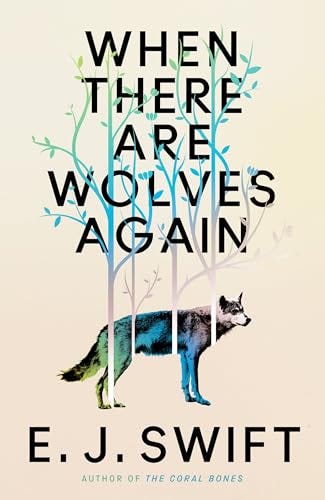
I’m starting this month off with a review of my favourite book I’ve read this year: When There Are Wolves Again by EJ Swift. It opens with two women meeting around a campfire in 2070, and then shows us the past half century through their eyes: from the covid lockdowns, through changes in government, a visionary royal bequest, catastrophic heatwaves and various rewilding efforts, to that cosy campfire in 2070. I don’t know if EJ Swift knew the term ‘Thrutopia’ while she was writing this book, but in my eyes it’s the most Thrutopian of novels!
During the 2020 lockdown, six-year-old Lucy is farmed out to her grandparents. They help her discover the natural world, as well as accepting her on her own terms in a way her parents seem unable to do.
In 2021, Hester is 36 and making a film about the Chornobyl Exclusion Zone, where it’s rumoured wolves and dogs have begun interbreeding. The spectre of Chornobyl looms large over the novel, not only because it feels like an expression of the larger tragedy of climate catastrophe, but because of the wolf-dogs that follow Hester throughout the next half-century, offering a tantalising glimpse of the possibility that novel’s title teases.
For the next 50 years, Hester and Lucy live their lives, occasionally intersecting, but never actually meeting in person. Meanwhile, the ‘interesting times’ keep coming. A change of government in the UK brings about a change in voting that enables some progressive policies to be introduced (great!). But the novel doesn’t shy away from bad stuff: there are violent heatwaves and impacts from the climate crisis, causing tragedies that we witness up close and personal through the eyes of our characters.
Lucy is hands-on in her approach to the world, from the bug hotels she creates in Gran’s garden to her involvement in a campaign to reclaim certain lands for the common people. Hester is more analytical, keeping the world at bay with her camera lens, even as her films chronicle major environmental shifts in the UK. She also embodies one of the central conflicts of the novel: whether to continue fighting increased flooding and other climate impacts on the Somerset Levels (as Hester’s farming family has done for generations), or whether to turn it over to nature and displace the people who have lived and worked so hard there for so long. One of the constant tensions of the novel is: how did we get here, and what do we need to do to get there? For me, the scenes set around the Somerset Levels, especially those that feature Hester’s tentative relationship with her hardworking brother, contain some of the book’s most moving moments.
Which brings me onto something else: there are very few bad people in this novel! There are people who do bad things, and people who strive to do good things, but the book reserves its worst criticisms for those who exploit others’ suffering for their own ends.
This newsletter is about Thrutopia – stories that plot grounded, plausible and inspiring route maps from a recognisable present towards a future we’d be proud to leave behind – and one of my favourite things about the novel is the plethora of ideas it supplies to help us through to a better future. There are SO MANY ideas: the Right to Roam plays a pivotal role early on, and near the end, a tarpaulin is casually referred to as one of ‘those mycelial ones that don’t crackle’. There are apps everywhere to reconnect people with nature. A fungus discovered at Chornobyl may offer a breakthrough for space travel, but this astounding technological development is juxtaposed with the reintroduction of lynx to the British countryside.
Yet even with all of this hope, the novel feels elegiac. The world as it used to be is gone, and we have to grieve that, even as we roll up our sleeves and get on with fostering the next one.
EJ Swift’s previous novels have been well received, but this one really seems to be striking a chord with readers. It won the British Science Fiction Association award for Best Novel in April, and the Arthur C. Clarke Award this week. It also deserves to break out of the speculative fiction bubble; EJ Swift is a superb writer and this novel is as urgent as any eco fiction you might come across.
The UK is currently enduring yet another heatwave; our infrastructure isn’t set up for this, and it’s been an uncomfortable few weeks for many people. It’s causing drought, wildfires, a drop in productivity and is likely to contribute to existing problems like food insecurity. More and more people are aware that climate change isn’t just coming: it’s here. Which has led to a lot of climate doomerism from people who feel helpless and frustrated.
This is where Thrutopia comes in: to point a way through the moment that is upon us. And that’s why books like When There are Wolves Again are so important, and why I believe this one has caught so many people’s imaginations. EJ Swift’s novel reflects the world we’re living in, and rallies us toward a future that’s worth fighting for. That’s worth us fighting for. It deserves to be the breakout novel of the year.
If this review has piqued your interest, please visit the publisher’s page for purchase links. And stay tuned for our interview with EJ Swift, coming later this month!
Sounds like a great book, I'll definitely read it. Thank you for the review.